


















/

/

Digital Ecosystem

Blog

The Role of Collega in Promoting the Sharia Digital Ecosystem in Indonesia

The Role of Collega in Promoting the Sharia Digital Ecosystem in Indonesia

Show

Show

11 November 2025

11 November 2025

Updated

Updated

15 Januari 2026

15 Januari 2026

The growth of Islamic economics in Indonesia has experienced positive momentum in recent years. Supported by the vast potential of the Muslim community and government policies that are pro-Islamic finance, this sector continues to develop into one of the important pillars in the national financial system. However, to realize a strong and inclusive Islamic digital ecosystem, collaboration among regulators, financial institutions, and technology providers is needed.
This is where Collega Inti Pratama plays an active role as a strategic partner in supporting the digital transformation of Islamic banking in Indonesia.

1. Great Potential of Islamic Finance Digitalization

Indonesia has over 200 million Muslim residents, making it the largest market for Islamic financial services in the world. However, the level of Islamic finance literacy and inclusion is still relatively low. Digitalization becomes the key to expanding the reach of services, providing modern user experiences, and improving the operational efficiency of Islamic banks.

Through the adoption of digital technologies—such as mobile banking, integration of Islamic payments, and digital-based financing systems—Islamic banks can reach more customers, especially in areas that have long been underserved by conventional banking.

2. Challenges in Islamic Digital Transformation

The digital transformation in the Islamic sector has unique characteristics that need to be managed carefully:

  • Compliance with Islamic principles. Every digital innovation must remain in accordance with halal, fair, and transparent principles.

  • Limitations of legacy systems. Many institutions still use conventional systems that are difficult to adapt to Islamic needs.

  • Lack of Islamic digital talent. Human resources are needed who understand both technology and Islamic finance principles.

  • The need for ecosystem collaboration. Transformation can only succeed if banks, fintech, regulators, and technology providers work together.

These challenges emphasize the importance of having technology partners who deeply understand the dynamics of the Islamic industry.

3. Collega's Collaboration with Islamic Banks

As a financial technology company with over two decades of experience, Collega Inti Pratama has been involved in various digital transformation projects in Islamic banking in Indonesia.
One example is the collaboration with Bank NTB Syariah, which utilizes Collega's solutions to build a Super App with a digital-first approach that makes it easier for customers to transact in accordance with Islamic principles.

Collega not only provides technology systems such as core banking, mobile banking, and digital payment integration, but also ensures that all implementations remain compliant with Islamic standards and OJK regulations. This approach helps Islamic banks transform without losing their identity and the values that underpin their operations.

4. Building an Inclusive Islamic Ecosystem

Collega's role does not stop at developing the internal systems of banks. Furthermore, Collega strives to build an ecosystem that connects various entities in Islamic finance—from fintech, BPRS, educational institutions, to Islamic business communities.
Through open architecture and API integration, Collega promotes cross-institution collaboration to create services that are more accessible and sustainable.

The goal is to create an inclusive, connected, and adaptive Islamic digital ecosystem to the developments in global technology.

5. Towards the Future of Indonesia's Digital Islamic Economy

The digital transformation of Islamic finance is not just about technological innovation, but also about strengthening values and trust. With the support of partners like Collega, Islamic banks in Indonesia have a great opportunity to grow as key players in an ethical and sustainable global financial ecosystem.

Collega believes that the future of Islamic finance in Indonesia will be shaped by the synergy between technology, Islamic principles, and the spirit of collaboration—toward a modern, inclusive ecosystem that brings benefits to all people.

Collega Inti Pratama – Together We Make IT Better.

Share

Related Articles

Related Articles

Related Articles

Illustration of the QRIS payment system in banking showing an EDC device with a QR Code in the center, a mobile phone with a banking app for scanning the QR, as well as a bank and merchant background as an integrated digital payment ecosystem.

Digital Ecosystem

Blog

QRIS Services in Banking: A Practical and Secure Digital Payment Solution

QRIS (Quick Response Code Indonesian Standard) is one of the latest innovative breakthroughs in the payment system. QRIS is a digital payment system based on QR Code that facilitates cashless transactions in banking.

What is QRIS?

QRIS (Quick Response Code Indonesian Standard) is the national QR Code standard established by Bank Indonesia to unify various digital payment methods into one system. With QRIS, transactions can be made using just one QR Code that can be utilized by various payment applications, including mobile banking and digital wallets.

In the context of banking, QRIS has become one of the strategic services to support quick, safe, and efficient cashless transactions.

The Role of QRIS in Banking Services

QRIS plays a vital role in expanding digital payment services in the banking sector. Through the integration of QRIS, banks can provide more inclusive and accessible transaction services for both customers and business actors.

Some of the main roles of QRIS in banking include:

  • Supporting the cashless society ecosystem

  • Facilitating retail and MSME transactions

  • Accelerating cashless payment processes

  • Increasing the adoption of mobile banking services

Benefits of QRIS Services for Banking

The implementation of QRIS brings various benefits to the banking industry, including:

  1. Improving Transaction Efficiency. QRIS reduces reliance on cash and accelerates the payment process.

  2. Expanding Service Reach. Banks can reach MSME players and a broader segment of the community with relatively low implementation costs.

  3. Enhancing Customer Experience. Transactions become more practical, fast, and convenient by simply scanning a QR Code.

  4. Supporting Transparency and Security. Each transaction is recorded d digitally, making tracking and reporting easier.

QRIS as Part of the Digital Banking Transformation

QRIS is a crucial part of the digital transformation of banking. By integrating QRIS into core banking systems and other digital services, banks can create a modern and connected payment ecosystem.

Moreover, QRIS also opens up integration opportunities with other services such as:

  • Mobile & Internet Banking

  • Transaction reporting systems

  • Analysis of customer transaction data

  • Development of other digital payment products

It can be concluded that the QRIS system services in banking become an effective digital payment solution to support cashless transactions in Indonesia. With ease of use, security, and support from national regulations, QRIS helps banks improve service quality, expand financial inclusion, and accelerate the digital transformation of banking.


Collega Inti Pratama – Together We Make IT Better.

Read more

Read more

Read more

Illustration of the Core Banking System as the hub of digital banking operations connected with bank branches, mobile and online banking, data security and compliance, transactions and accounts, fintech and API integration, as well as loan and savings services.

Core Banking

Blog

Core Banking System: Understanding, Functions, and Its Role in the Digital Transformation of Banking

In the era of digital as it is now, the banking industry is required to move quickly, safely, and efficiently in serving customers. Behind various banking services that we use every day—from cash withdrawals, transfers, to mobile banking—there is a core system that is the backbone of bank operations, namely Core Banking System.

What is Core Banking System?

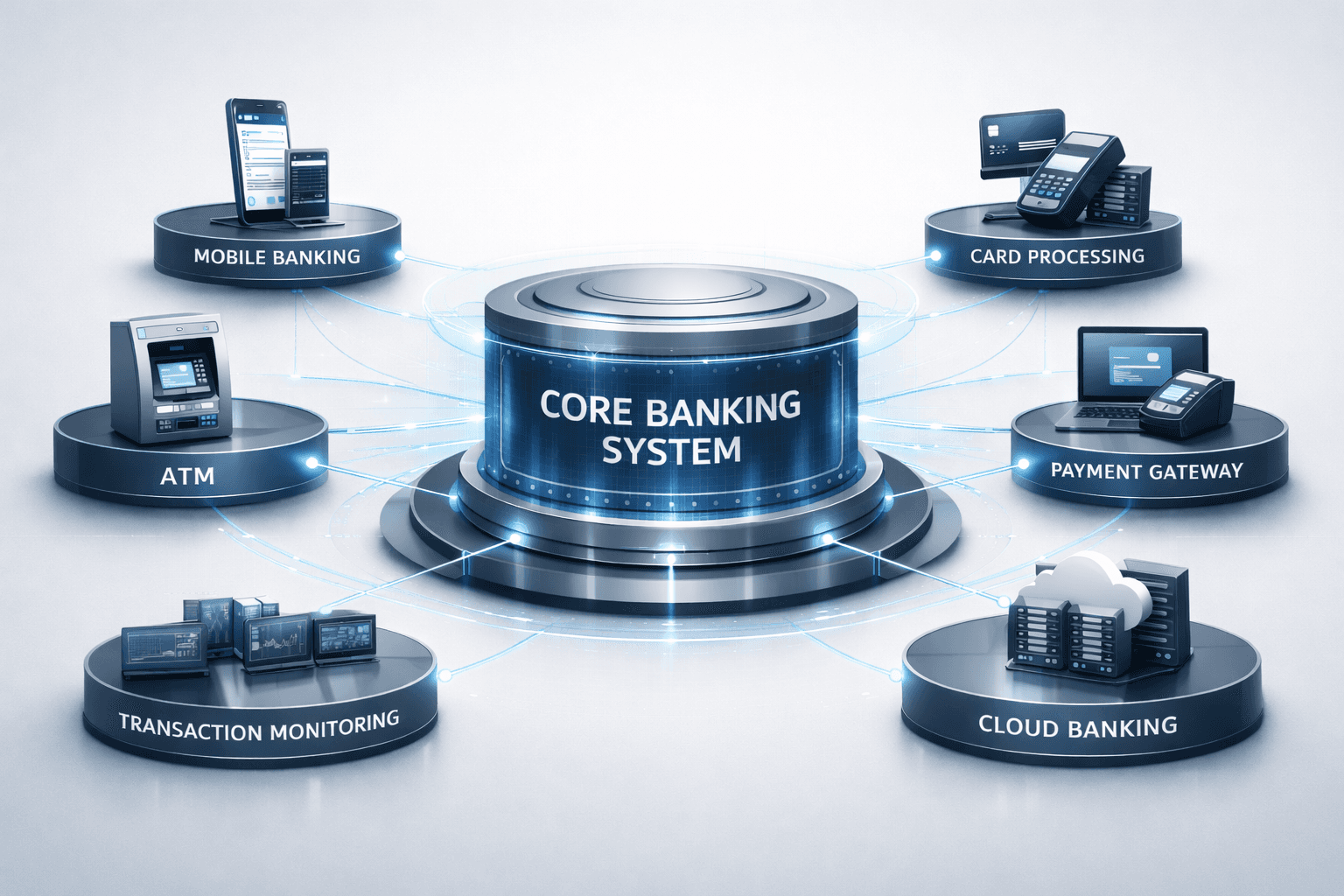
Core Banking System (CBS) is the primary system used by banks to run all core business processes in a centralized, integrated, and real-time manner. This system serves as the foundation of banking operations in managing customer data, financial transactions, banking products, and reporting.

With the Core Banking System, customers can perform transactions anytime and anywhere through various channels such as branch offices, ATMs, mobile banking, and internet banking, with data that is always synchronized within one system.

Functions of the Core Banking System

Core Banking System plays a vital role in ensuring the bank's operations run efficiently and safely. Here are some of its main functions:

  1. Centralized Customer Data Management. CBS stores all customer data in one integrated system, making it easier to manage, monitor, and update data accurately.

  2. Real-Time Transaction Processing. This system allows banking transactions such as deposits, withdrawals, fund transfers, payments, and financing to be conducted in real-time without delays.

  3. Management of Banking Products and Services. The Core Banking System supports the management of various banking products such as savings, checking accounts, deposits, loans, and financing with flexible configurations.

  4. Compliance with Regulations. CBS assists banks in meeting regulatory requirements through automatic reporting features, audit trails, and internal controls.

  5. Multi-Channel Integration. The Core Banking System connects with various digital service channels, providing a consistent service experience for customers.

Benefits of the Core Banking System

The implementation of a modern Core Banking System provides many strategic benefits, including:

  • Increasing Operational Efficiency
    Automated processes reduce manual work and the risk of human error.

  • Enhancing Customer Service Quality
    Fast and accurate transactions increase customer trust and satisfaction.

  • Data and Transaction Security
    The Core Banking System is equipped with multi-layer security systems to protect sensitive customer data.

  • Supporting Business Scalability
    Banks can easily develop new products and expand services as the business grows.

The Role of the Core Banking System in Digital Banking Transformation

In the digital era, the Core Banking System becomes the main key to banking transformation. A flexible core system enables banks to adopt modern technologies such as API Integration, Open Banking, Cloud Computing, and collaboration with fintech.

Without a reliable Core Banking System, the development of digital services will be hindered, making it difficult to compete in an increasingly competitive banking industry.

It can be concluded that the Core Banking System is the primary foundation that determines the success of operational and digital banking transformation. With a modern core system, banks can enhance efficiency, security, and service quality to customers while preparing to face future technological developments.


Collega Inti Pratama – Together We Make IT Better.

Read more

Read more

Read more

Events & Webinars

Digital Transformation with No-Code Development to Drive Business Growth

PT Collega Inti Pratama collaborates with PT Jojo Nomic Indonesia and is supported by PT Telkom Indonesia (Persero) Tbk to hold a webinar conducted online with the theme “Digital Transformation with No-Code Development to Drive Business Growth” on October 14, 2021.

Read more

Read more

Read more

Events & Webinars

Collega Readiness Sharing Session in Digital Lending Implementation

The presence of Digital Lending as a solution to facilitate the loan application process for customers, as well as to support the growth of the banking business in the future. This digitization is expected to help reduce the number of unbanked and underserved individuals in Indonesia, which can be a key element for national economic growth.

Read more

Read more

Read more

© 2026 PT Collega Inti Pratama. All Rights Reserved.

Privacy Policies

Sitemap

Address

Talavera Office Park

Jl. Letjen TB. Simatupang Kavling 22 - 26 Cilandak South Jakarta 12430

+622175924428

+622175924408

marketing@collega.co.id

© 2026 PT Collega Inti Pratama. All Rights Reserved.

Privacy Policies

Sitemap

Address

Talavera Office Park

Jl. Letjen TB. Simatupang Kavling 22 - 26 Cilandak South Jakarta 12430

+622175924428

+622175924408

marketing@collega.co.id

© 2026 PT Collega Inti Pratama. All Rights Reserved.

Privacy Policies

Sitemap